When Family Stories Travel Beyond the Kitchen Table
Learn how to preserve family stories as they travel between tellers: keep the people, sequence, and uncertainty clear while leaving the wording alive.
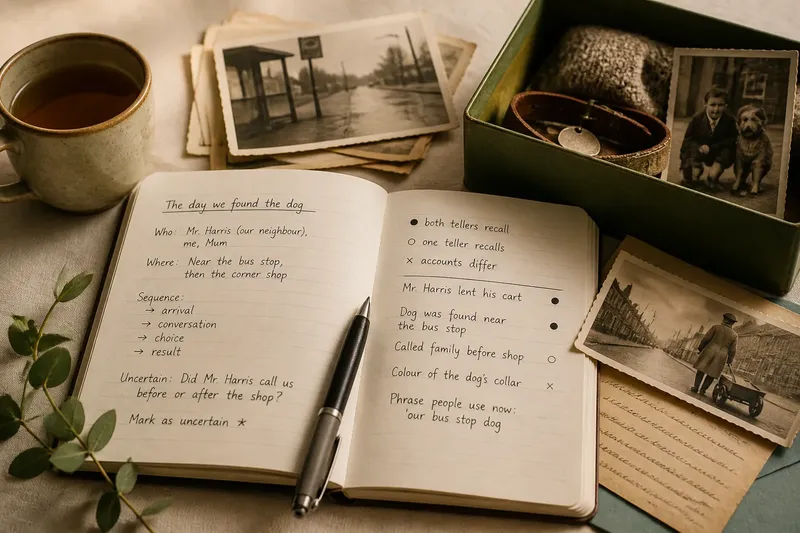
A family story can reach a cousin who has never heard it and still feel like the same story, even when the sentences change. To preserve family stories as they travel, protect the details that give an account its shape while allowing each teller to use their own words.
That balance gets harder as stories move from one generation or branch of a family to another. A pause becomes a certainty, a supporting character disappears, or a familiar phrase starts sounding like a verbatim quotation. These slips usually have ordinary causes, and a few careful habits can keep them from accumulating.
Why does the story change when another person tells it?
People retell from memory, not from a recording. They keep what seems meaningful, fill gaps with what they already know, and adjust the pacing for the listener in front of them. A grandchild might turn a long account into a quick anecdote; an aunt might restore a detail that makes a decision understandable.
Variation is not automatically a flaw. Spoken stories need room to breathe, and a teller’s emphasis can reveal what the account means to them now. The trouble begins when a changed detail is passed along as though every teller agreed on it.
Before asking someone to retell a story, identify what matters to preserve: who was involved, what happened in what order, and which details are uncertain. Treat those points like the parts of a recipe that make the dish recognizable; the cook can still season it in their own way.
What should you try when the sequence gets muddled?
A story can become confusing when several events are compressed into one scene. Listeners may then assign an action to the wrong person or mistake a later consequence for the original cause. This often happens because a teller remembers the outcome more vividly than the steps that led there.
Ask for the sequence in plain language rather than challenging the teller’s memory: “What happened just before that?” or “Who was there when the decision was made?” Then note the order as a short chain, such as arrival, conversation, choice, and result. Keep the notes as prompts, not a script.
Say you are trying to pass on an invented family account about a neighbor bringing a lost dog home. You remember the dog was found near a bus stop, but not whether the neighbor called the family before or after taking it to a nearby shop. Mark that order as uncertain instead of choosing the version that makes the neatest story; later tellers can preserve the uncertainty along with the known events.
How can you stop a supporting person from disappearing?
Retellings often center the person who tells the story most often. A relative who supplied a tool, made a phone call, or challenged a decision can vanish because their role seems small in the moment. Later, the central character may appear to have acted alone.
When a person’s role matters to the account, record their relationship or contribution in a few words. “A neighbor lent the cart” is more useful than a vague note that “someone helped.” If the person’s name is not known, do not invent one; a clear description can carry the role forward.
It also helps to ask who was absent from the usual version. That question is not an accusation. It is a way to notice whether the story leaves out someone whose contribution changes how listeners understand what happened.
What if two relatives remember different details?
Conflicting memories can emerge when people stood in different places, heard different parts of a conversation, or learned the story at different times. A disagreement does not mean one person is lying. It may mean the family has been carrying two accounts that were never compared.
Write down each version separately before trying to combine them. Mark who told it and which details they remember; do not turn a shared note into a vote. If the accounts overlap on the central event but differ on a time, object, or phrase, preserve that distinction rather than selecting whichever detail sounds more polished.
Use a simple set of labels in private notes: “both tellers recall,” “one teller recalls,” and “accounts differ.” These labels make room for clarity without placing a verdict on anyone’s memory. If relatives later agree on a detail, update the note and keep a record of the earlier difference when it remains relevant.
How do you keep a vivid phrase from becoming a false quotation?
Memorable language travels easily. A teller may say, “She always called it the blue room,” as a summary of a habit, and another person may later put those words in quotation marks. A sharp line can make a story more engaging, but quotation marks imply that the wording itself is remembered.
Use direct quotation only when someone has a recording, written note, or clear recollection of the exact words. Otherwise, report the sense of the remark without quotation marks: “She called the room blue,” or “He remembered her as someone who disliked the paint.” These small distinctions keep a vivid retelling from claiming more than its source can support.
When a phrase matters because it is part of family language, say that it is the phrase people now use, rather than presenting it as a precise line spoken long ago. The distinction lets the phrase remain meaningful while showing how it reached the present.
What can you do when a story feels too polished?
A tidy story can hide uncertainty, awkwardness, or an unresolved choice. That polish often comes from repeated retellings: details that complicate the point are dropped, and a clear ending is added even when nobody remembers one. The account may still carry truth, but listeners can mistake a satisfying shape for a complete record.
Try asking what the teller does not remember, rather than pressing for a missing detail. Keep an unresolved ending unresolved. If the story contains an interpretation—such as why someone left or what a gesture meant—separate it from the observable action: “He put the letter in a drawer” is different from “He wanted to forget her.”
That separation does not drain a story of feeling. It gives later listeners a fair chance to hear the event and the family’s interpretation as two related, but distinct, things.
How can you pass a story on without scripting the next teller?
Rigid wording can make a family story sound like an official account, discouraging people from adding their own perspective. But an unmarked retelling can erase where a detail came from. A useful middle ground is a short story note that records anchors and provenance, not finished prose.
- Name the teller or tellers and how they are connected to the events.
- Record the people involved, using names or clear descriptions.
- Write the main events in sequence, including the turning point.
- Mark details that are remembered by one person, disputed, or unknown.
- Separate remembered wording from a paraphrase or a phrase used in later retellings.
- Note what the story means to the teller, without presenting that meaning as the only interpretation.
Share the note alongside an invitation to tell the story in a natural voice. A listener might add a context that earlier tellers did not know, or explain why a detail matters to another branch of the family. Keep additions attributed, so new knowledge enriches the account without silently replacing its earlier versions.
Questions people ask about family stories?
Should every version of a family story be recorded?
No. Preserve versions that add a meaningful perspective, clarify a detail, or show a genuine disagreement. A note that captures who remembers what can be more useful than collecting every casual retelling.
How do you record a story if the teller dislikes recording devices?
Ask permission before using a phone or recorder, and offer handwritten notes instead. You can also ask the teller to review a short summary so they can correct wording or identify details they would rather keep private.
What if a relative asks you to leave out a sensitive detail?
Respect the request when you share the account, and make clear to other listeners that the version is partial if that context matters. For a private family record, agree together on who may see it and whether any detail should remain unrecorded.
Can a story be accurate if its wording keeps changing?
Yes. Accuracy depends on making a fair distinction between remembered events, uncertain details, and later interpretation, not on repeating identical sentences. Family stories can preserve their essential shape while each teller gives them a voice of their own.
When should you revisit the story note?
Return to the note when a new teller adds a detail, a relative corrects a role, or the story is about to be shared with people outside the family. Check whether the account still distinguishes what is known from what is remembered differently. If you cannot resolve a point, label it instead of smoothing it away.
That small pause gives the next teller something sturdier than a polished script: people, sequence, and honest uncertainty. It also keeps family stories traveling as living accounts, shaped by new voices without losing track of what those voices inherited.